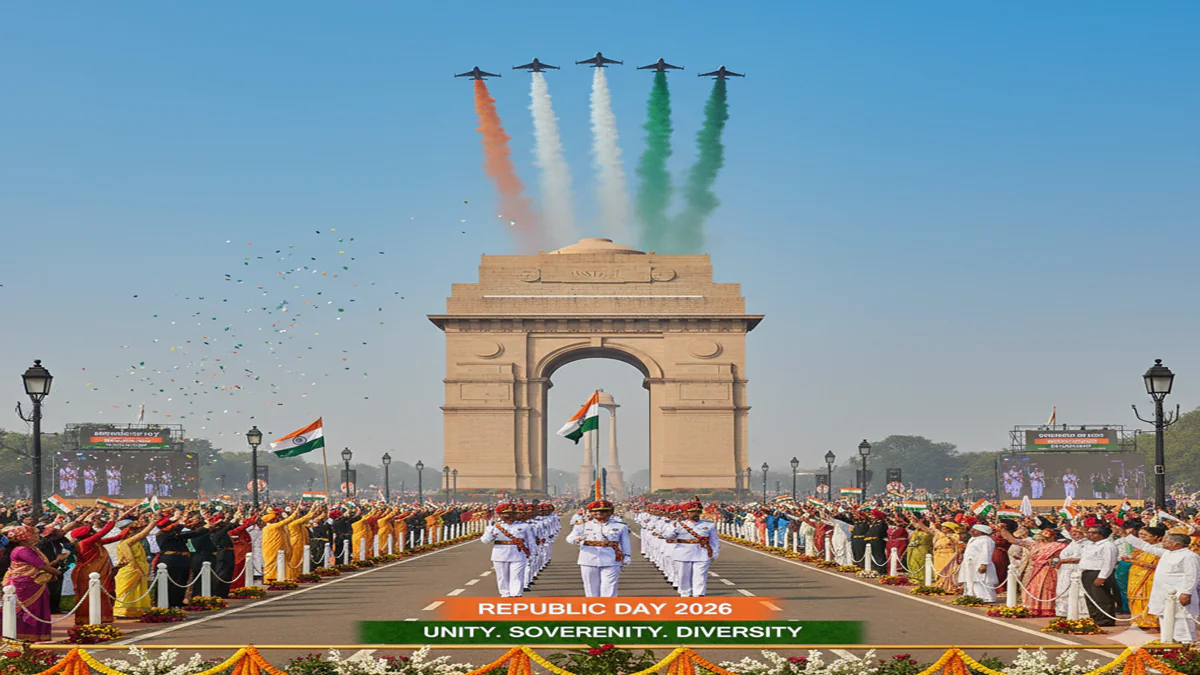
Republic Day 2026: Reflecting on 76 Years of India’s Constitutional Journey
Date:January 26, 2026
Introduction: The Dawn of Constitutional Sovereignty
26 January Republic Day Special 2026 On January 26, 1950, a newly independent India awoke not just to another morning, but to a new identity. The Constitution of India—a remarkable document painstakingly crafted over 2 years, 11 months, and 18 days—came into effect, transforming the nation from a British Dominion into a sovereign democratic republic. As we approach Republic Day 2026, marking 76 years of this constitutional journey, we find ourselves at a poignant intersection of reflection and anticipation. This Republic Day is not merely a ceremonial observance but an opportunity to assess how far we’ve traveled on the path laid down by our founding document, and what lies ahead for the world’s largest democracy.
The Historical Significance: More Than a Date Choice
The selection of January 26 was profoundly symbolic. This date commemorated the 1930 “Purna Swaraj” declaration by the Indian National Congress, which first articulated India’s demand for complete independence from British rule. Twenty years before the Constitution took effect, on January 26, 1930, Indians first raised the flag of independence and affirmed their right to self-governance.
Dr. Rajendra Prasad, who would become India’s first President, captured the moment’s significance in his inaugural address: “We have to build the noble mansion of free India where all her children may dwell.” The Constitution provided the architectural blueprint for that mansion—one founded on justice, liberty, equality, and fraternity.
The Constitution: A Living Document in a Changing World
Foundational Principles
The Indian Constitution, the longest written constitution of any sovereign nation, was revolutionary in its inclusivity and foresight. Its 395 original articles and 8 schedules wove together diverse influences—from the Government of India Act 1935 to concepts borrowed from constitutions worldwide, yet rooted firmly in Indian realities.
What set India’s founding document apart was its commitment to affirmative action through reservation policies, its recognition of linguistic diversity while establishing Hindi as an official language, and its delicate balance between a strong central government and state rights. The Directive Principles of State Policy—non-justiciable but fundamental to governance—reflected the constitutional vision of a welfare state.
Evolution Through Amendment
As we approach 2026, the Constitution has been amended 106 times, reflecting its nature as a living document. These amendments have addressed changing social realities—from land reforms in early years to the recent constitutional status for the National Commission for Backward Classes. Each amendment represents a national conversation about who we are and who we aspire to be.
The basic structure doctrine, established by the Supreme Court in the Kesavananda Bharati case (1973), has ensured that while the Constitution can evolve, its foundational principles remain inviolable. This delicate balance between adaptability and integrity has allowed India’s democracy to survive challenges that have toppled other post-colonial democracies.
Republic Day 2026: Theme and Contemporary Relevance
While the official theme for Republic Day 2026 will be announced closer to the date, it is likely to reflect current national priorities and global standing. Potential themes might include:
- “Constitutional Values in a Digital Age”– Examining fundamental rights and governance in an era of artificial intelligence, digital privacy concerns, and cyber sovereignty.
- “Vasudhaiva Kutumbakam in Practice”– Exploring how India’s ancient philosophy of “the world is one family” informs its contemporary foreign policy and domestic pluralism.
- “Green Republic: Sustainable Development Constitutional Commitments”– Connecting environmental stewardship to constitutional mandates.
Regardless of the specific theme, Republic Day 2026 will undoubtedly occur amid significant global and domestic contexts: India’s growing economic prominence, ongoing social transformations, technological disruptions, and its leadership role in the Global South.
The Grand Celebration: Tradition Meets Innovation
The Ceremonial Heart: Kartavya Path
The Republic Day parade along Kartavya Path (formerly Rajpath) remains the centerpiece of celebrations, a magnificent display of India’s military prowess, cultural diversity, and technological achievements. By 2026, we can anticipate several evolutions in this tradition:
- Technological Integration:Enhanced virtual and augmented reality experiences allowing global audiences to participate remotely.
- Environmental Consciousness:A “green parade” with electric vehicle displays, sustainable materials, and carbon-neutral planning.
- Expanded Participation:Greater representation from India’s entrepreneurial ecosystem, scientific community, and local governance institutions.
The Beating Retreat Ceremony
Three days after Republic Day, the Beating Retreat ceremony at Vijay Chowk marks the formal end of celebrations. This tradition, with roots in British military practice, has been thoroughly Indianized with Indian compositions and instruments. By 2026, we might witness a fusion of traditional and contemporary music forms, reflecting India’s evolving cultural landscape.
Constitutional Challenges and Triumphs: A 76-Year Report Card
Democratic Resilience
India’s most significant constitutional achievement has been the maintenance of a functioning democracy against considerable odds—linguistic diversity, religious pluralism, economic disparities, and regional variations. The regular conduct of free and fair elections, including the world’s largest electoral exercise, stands as testament to institutional strength.
Social Justice Endeavors
The Constitution’s commitment to social justice has produced mixed results. While affirmative action has created new avenues for historically marginalized communities, significant disparities persist. The 2026 observance provides an opportunity to assess initiatives like the 103rd Constitutional Amendment (2019) providing economic reservation, and their impact on creating a more equitable society.
Federal Balance
The Centre-State dynamic continues to evolve, with recent debates around cooperative versus competitive federalism. The constitutional division of powers faces new tests from emerging issues like climate change, cybersecurity, and pandemic response that don’t fit neatly into existing frameworks.
Fundamental Rights in the Digital Era
As we approach 2026, classic debates around freedom of expression, privacy, and state security have migrated to digital spaces. The Supreme Court’s recognition of the right to privacy as a fundamental right (2017) and subsequent data protection legislation represent ongoing constitutional adaptation to technological change.
The Youth and the Constitution: Passing the Torch in 2026
With over 50% of India’s population below 25 years of age, Republic Day 2026 presents a crucial opportunity for intergenerational constitutional dialogue. Initiatives likely to gain prominence include:
- Digital Constitution Literacy:Mobile applications and interactive platforms making constitutional knowledge accessible and engaging.
- Youth Parliament Initiatives:Expanded programs bringing constitutional debates to educational institutions.
- Constitutional Entrepreneurship:Encouraging social enterprises addressing contemporary challenges through constitutional principles.
The “New India” envisioned by its youth must reconcile traditional values with global citizenship, economic aspiration with environmental sustainability, and individual rights with collective responsibilities—all within the constitutional framework.
Global Context: India’s Constitutional Democracy in the World
As the world grapples with democratic backsliding and authoritarian resurgence, India’s constitutional continuity assumes global significance. Republic Day 2026 occurs amid India’s growing international leadership role, whether through G20 presidency or UN Security Council membership.
India’s constitutional journey offers lessons for emerging democracies: the importance of institutional resilience, the balance between majority rule and minority rights, and the possibility of maintaining national unity while celebrating diversity. Conversely, India also faces international scrutiny regarding how well its constitutional ideals match ground realities—particularly regarding religious freedom, press independence, and minority protections.
The Road Ahead: Constitutional Vision for India@100
As India approaches its centennial of independence in 2047, Republic Day 2026 serves as a crucial milestone. Several constitutional considerations will likely dominate national discourse:
- Comprehensive Constitutional Review:While the basic structure remains sacrosanct, some scholars advocate for a comprehensive review to address accumulated amendments and contemporary challenges.
- Local Governance Strengthening:Further decentralization through empowered local bodies, potentially through constitutional amendments.
- Environmental Constitutionalism:Explicit constitutional recognition of environmental rights and climate responsibilities.
- Digital Rights Framework:Comprehensive constitutional guidance for digital governance, AI ethics, and cyber rights.
Personal Responsibility: Constitutional Patriotism Beyond Symbolism
True constitutional patriotism moves beyond flag-hoisting ceremonies to daily practice. As we approach Republic Day 2026, each citizen might consider:
- How do my daily actions reflect constitutional values?
- Do I exercise my rights while remembering my responsibilities?
- How do I contribute to creating the “dignity of the individual” and “unity of the nation” the Preamble envisions?
Conclusion: The Unfinished Project of Republican India
The Constitution of India began not with “We, the Government” but with “We, the People.” This simple phrase captures the revolutionary essence of Indian republicanism—that sovereignty resides not in rulers but in citizens. As we celebrate 76 years of this remarkable experiment, we recognize that constitutionalism is not a destination achieved but a continuous practice.
Republic Day 2026 finds India at a crossroads familiar yet unprecedented—balancing tradition with innovation, diversity with unity, rights with duties, national interest with global responsibility. The constitutional framework has proven remarkably resilient, bending without breaking through decades of change.
As the sun rises over Delhi on January 26, 2026, and the President unfurls the tricolor, the moment will symbolize not just pride in how far we’ve come, but collective responsibility for where we must go. The mansion of free India that Dr. Prasad envisioned remains under construction, with each generation adding rooms, strengthening foundations, and ensuring shelter for all.
The true celebration of Republic Day lies not in ceremonial displays but in recommitting to constitutional values in our homes, workplaces, communities, and hearts. For in the final analysis, a constitution is only as strong as the citizens who uphold it, and a republic only as noble as the people who constitute it.
Frequently Asked Questions (FAQs)
1. Why is Republic Day celebrated on January 26 specifically?
Republic Day is celebrated on January 26 to commemorate the date in 1950 when India’s Constitution came into effect. However, the date holds additional historical significance—it marks the anniversary of the 1930 “Purna Swaraj” declaration when the Indian National Congress first proclaimed complete independence from British rule. Thus, the date symbolically connects the demand for self-rule with its constitutional realization twenty years later.
2. How is Republic Day 2026 likely to be different from previous celebrations?
Republic Day 2026, marking 76 years of the Constitution, is expected to feature several distinctive elements:
- Greater integration of technology for virtual participation and enhanced viewer experience
- Likely focus on contemporary themes like digital rights, environmental constitutionalism, or India’s global leadership
- Expanded representation of India’s entrepreneurial and innovation ecosystem in the parade
- Possibly the inclusion of new military equipment and indigenous technologies
- Increased emphasis on youth engagement with constitutional values
3. What is the difference between Republic Day and Independence Day?
While both are national holidays celebrating India’s freedom, they mark different milestones:
- Independence Day (August 15):Commemorates India’s liberation from British colonial rule in 1947 and the beginning of political independence.
- Republic Day (January 26):Celebrates the adoption of India’s Constitution in 1950, establishing India as a sovereign democratic republic with its own governing framework.
Essentially, Independence Day marks freedom from foreign rule, while Republic Day celebrates freedom to self-govern through a constitutional framework.
4. How has the Indian Constitution evolved since 1950?
The Constitution has evolved significantly while maintaining its basic structure:
- Amendments:106 amendments as of 2024, addressing changing social, economic, and political realities
- Judicial Interpretation:Landmark Supreme Court judgments have expanded fundamental rights (like privacy) and established critical doctrines (like basic structure)
- New Institutions:Creation of constitutional bodies like the GST Council, National Green Tribunal, etc.
- Rights Expansion:Through laws and judicial interpretation, new dimensions of rights have been recognized, including environmental rights and digital rights
- Federal Evolution:Changing dynamics in Centre-State relations through various commissions and political developments
5. How can citizens meaningfully participate in Republic Day beyond watching celebrations?
Meaningful citizen participation extends beyond ceremonial observation:
- Constitutional Literacy:Educate yourself and others about constitutional rights and duties
- Community Engagement:Participate in local events discussing constitutional values
- Digital Participation:Engage with official virtual events and discussions
- Civic Action:Exercise your democratic rights responsibly through voting and informed advocacy
- Daily Practice:Embody constitutional values like equality, fraternity, and justice in daily interactions
- Youth Mentorship:Guide younger generations in understanding their constitutional heritage
- Conscious Consumption:Support initiatives that promote constitutional values in business and media
True republicanism is practiced daily, not just celebrated annually.