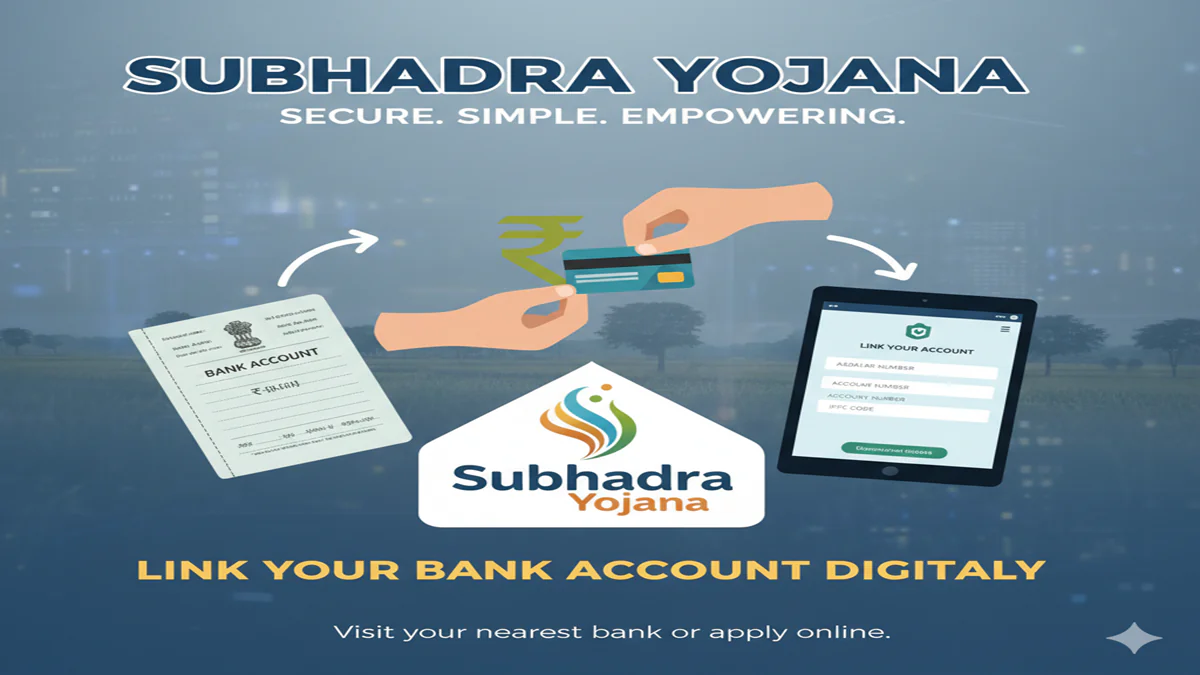
Subhadra Yojana Bank Account Link: सुभद्रा योजना का पैसा पाने के लिए बैंक खाते को आधार से कैसे जोड़ें? जानें पूरी प्रक्रिया और DBT इनेबल करने का तरीका!
Subhadra Yojana Bank Account Link: Introduction: महिला सशक्तिकरण के लिए शुरू की गई ‘सुभद्रा योजना’ (Subhadra Yojana) महिलाओं के जीवन में एक बड़ा बदलाव ला रही है। इस योजना के तहत सरकार लाभार्थियों को ₹50,000 की कुल सहायता राशि प्रदान कर रही है। लेकिन, कई महिलाओं को आवेदन मंजूर होने के बावजूद पैसे नहीं मिल पा रहे हैं। इसका सबसे बड़ा कारण है—बैंक खाते का आधार से लिंक न होना (Bank Account Not Linked with Aadhaar)।
सरकारी नियमों के अनुसार, सुभद्रा योजना का लाभ केवल उन्हीं महिलाओं को मिलेगा जिनका बैंक खाता DBT (Direct Benefit Transfer) के लिए सक्रिय है। यदि आप भी इस समस्या से परेशान हैं, तो यह लेख आपके लिए है। यहाँ हम विस्तार से जानेंगे कि Subhadra Yojana Bank Account Link की प्रक्रिया क्या है और आप घर बैठे अपना स्टेटस कैसे चेक कर सकते हैं।
1. आधार-बैंक लिंकिंग और DBT क्यों जरूरी है?
Subhadra Yojana Bank Account Link: आजकल सरकार किसी भी योजना का पैसा सीधे बैंक खाते में भेजती है। इसे ‘DBT’ कहा जाता है। इसके लिए दो चीजें अनिवार्य हैं:
- Aadhaar Seeding: आपके बैंक खाते में आधार नंबर दर्ज होना चाहिए।
- NPCI Mapping: आपका बैंक खाता भारतीय राष्ट्रीय भुगतान निगम (NPCI) के सर्वर पर आधार से जुड़ा होना चाहिए, ताकि सरकारी पैसा सही खाते में पहुंच सके।
2. बैंक खाते को आधार से लिंक करने के तरीके (Method to Link)
A. बैंक शाखा में जाकर (Offline Method):
- Subhadra Yojana Bank Account Link: अपनी उस बैंक शाखा में जाएं जहाँ आपका खाता है।
- वहां से ‘Aadhaar Seeding Form’ या ‘DBT/NPCI Mapping Form’ मांगें।
- फॉर्म में अपना आधार नंबर और बैंक विवरण भरें।
- आधार कार्ड की फोटोकॉपी संलग्न करें और मैनेजर को जमा करें।
- बैंक अधिकारी 24 से 48 घंटों में आपका खाता लिंक कर देंगे।
B. नेट बैंकिंग के माध्यम से (Online Method):
- Subhadra Yojana Bank Account Link: अपने बैंक की वेबसाइट या मोबाइल ऐप पर लॉग-इन करें।
- ‘Service Request’ या ‘Aadhaar Linking’ विकल्प पर जाएं।
- अपना आधार नंबर दर्ज करें और OTP के जरिए वेरिफाई करें।
- सफलतापूर्वक सबमिट होने पर आपको कन्फर्मेशन मैसेज मिलेगा।
3. स्टेटस कैसे चेक करें? (Check Link Status Online)
Subhadra Yojana Bank Account Link: आपका खाता लिंक है या नहीं, यह जानने के लिए नीचे दिए गए स्टेप्स फॉलो करें:
- आधार की आधिकारिक वेबसाइट
uidai.gov.inपर जाएं। - ‘My Aadhaar’ सेक्शन में जाकर ‘Bank Seeding Status’ पर क्लिक करें।
- आपके रजिस्टर्ड मोबाइल पर एक OTP आएगा, उसे भरें।
- स्क्रीन पर दिखाई देगा कि आपका आधार किस बैंक से लिंक है और वह ‘Active’ है या नहीं।
4. सुभद्रा योजना का पैसा नहीं आने पर क्या करें?
Subhadra Yojana Bank Account Link: अगर आपका नाम लिस्ट में है लेकिन पैसा नहीं आया, तो ये चीजें चेक करें:
- e-KYC: सुनिश्चित करें कि आपके बैंक खाते की ई-केवाईसी पूरी हो चुकी है।
- Multiple Accounts: यदि आपके पास एक से अधिक बैंक खाते हैं, तो चेक करें कि आधार किस खाते में लिंक है। पैसा उसी खाते में जाएगा जो NPCI पर मैप है।
- In-Active Account: यदि आपने लंबे समय से खाते से लेन-देन नहीं किया है, तो वह ‘Dormant’ (निष्क्रिय) हो सकता है। इसे सक्रिय करने के लिए बैंक में जाकर ₹100 जमा या निकालें।
4. अक्सर पूछे जाने वाले प्रश्न (FAQs)
Q1: क्या सुभद्रा योजना के लिए नया बैंक खाता खोलना जरूरी है?
Ans: नहीं, आप अपने पुराने खाते को ही आधार से लिंक करके लाभ ले सकती हैं। बस वह खाता चालू (Active) होना चाहिए।
Q2: NPCI मैपिंग में कितना समय लगता है?
Ans: बैंक में आवेदन देने के बाद आमतौर पर 3 से 7 कार्य दिवसों में मैपिंग पूरी हो जाती है।
Q3: क्या पोस्ट ऑफिस का खाता सुभद्रा योजना के लिए चल सकता है?
Ans: हाँ, इंडिया पोस्ट पेमेंट्स बैंक (IPPB) का खाता सरकारी योजनाओं के लिए सबसे अच्छा माना जाता है क्योंकि इसमें DBT बहुत जल्दी सक्रिय होता है।
Conclusion: समय पर करें काम, पाएं पूरा लाभ!
Subhadra Yojana Bank Account Link की प्रक्रिया जटिल नहीं है, बस थोड़ी सावधानी की जरूरत है। यदि आप चाहते हैं कि आपकी 2026 की किस्त बिना किसी रुकावट के आए, तो आज ही अपना आधार स्टेटस चेक करें और बैंक जाकर उसे अपडेट करवाएं। डिजिटल इंडिया के इस दौर में अपनी आर्थिक सुरक्षा सुनिश्चित करना आपके ही हाथ में है।
The Subhadra Yojana Bank Account Link: A Comprehensive Guide to Financial Inclusion for Women in Odisha
Subhadra Yojana Bank Account Link In the landscape of government welfare schemes, a successful program is more than just a financial allocation; it’s a bridge between policy and people, between intent and impact. The Subhadra Yojana, announced by the Government of Odisha, aims to be precisely such a bridge for millions of women across the state. At the heart of this transformative scheme lies a critical, yet sometimes overlooked, component: the Subhadra Yojana Bank Account Link.
Subhadra Yojana Bank Account Link: This isn’t merely a technical step of connecting an Aadhaar number to a bank account. It is the fundamental pipeline that ensures the scheme’s lifeblood—financial support and empowerment—reaches its intended beneficiaries directly, securely, and with dignity. This article delves deep into the what, why, and how of this crucial link, providing a complete guide for eligible women and stakeholders.
Understanding the Subhadra Yojana: The Foundation
Subhadra Yojana Bank Account Link: Before we examine the account link, it’s essential to understand the scheme itself. Announced in the run-up to the 2024 state elections, the Subhadra Yojana is a women-centric financial empowerment initiative. Its core promise is to provide eligible women in Odisha with avoucher worth ₹50,000.
However, this is not a direct cash transfer. The voucher operates on a “2+1” model:
- Two Years: The voucher has a maturity period of two years.
- One Year: After maturity, the beneficiary can redeem the voucher and utilize the funds for a period of one year.
Subhadra Yojana Bank Account Link: This structure is designed to encourage savings and planned expenditure, allowing women to invest in income-generating assets, education, healthcare, or housing, rather than facilitating immediate consumption.
Eligibility Criteria (Broadly Defined):
While the final, detailed guidelines are awaited from the state government, the announced eligibility is expected to target:
- Adult women (likely above 18 or 21 years of age).
- Residents of Odisha.
- Women belonging to economically disadvantaged sections, possibly with an annual family income ceiling.
- The scheme aims to cover a staggering 70 lakh (7 million) women across the state.
The Critical Role of the Bank Account Link: Why It’s Indispensable
Subhadra Yojana Bank Account Link: The bank account link is the spinal cord of the Subhadra Yojana. Here’s why it’s non-negotiable:
1. Direct Benefit Transfer (DBT): The Cornerstone of Modern Welfare
The Government of India and state governments have aggressively moved towards the DBT model to transfer subsidies and benefits. Linking a bank account enables:
- Zero Leakage: Funds are transferred directly from the government’s treasury to the woman’s personal account, eliminating middlemen, delays, and corruption.
- Empowerment & Ownership: Money lands in her account, giving her full control over the funds. This financial autonomy is a core objective of the scheme.
- Transparency: Every transaction is recorded digitally, allowing for easy tracking and grievance redressal.
2. Secure Redemption of the Voucher
Subhadra Yojana Bank Account Link: After the 2-year maturity, the ₹50,000 voucher must be converted into usable funds. This redemption will almost certainly happen through a bank-led process. A linked, active account is where the funds will be deposited or against which the voucher will be monetized.
3. Enabling a Financial Ecosystem
Subhadra Yojana Bank Account Link: A bank account is not just a destination for funds; it’s a gateway to the formal financial system. Once the voucher amount is deposited, the woman gains:
- Access to Banking Services: She can save securely, earn interest, and use services like ATMs, cheques, and online banking.
- Credit History: A functioning account begins a formal financial footprint, which can help in securing loans in the future.
- Linkage to Other Schemes: The same account can be used for other DBT benefits like PM-KISAN, scholarships, or pensions, creating a consolidated financial hub for the family.
4. Verification and KYC Compliance
Subhadra Yojana Bank Account Link: A bank account that is linked with Aadhaar (as per KYC norms) serves as a robust verification tool. It confirms the beneficiary’s identity, address, and existence, reducing fraud and ensuring that the benefit reaches the right person.
Step-by-Step: How to Establish the Subhadra Yojana Bank Account Link
Subhadra Yojana Bank Account Link: While the official portal and application process for Subhadra Yojana are under development, the steps to ensure your bank account is “scheme-ready” are clear and proactive. Follow this guide:
Prerequisite Checklist:
- A valid Aadhaar Card (linked with current mobile number for OTP).
- An active bank account (Savings Account) in any recognized bank (Public Sector, Private, or Regional Rural Bank).
- Bank account linked with Aadhaar (this is crucial).
- CSC/ Bank Mitra details, if you need assistance.
Expected Process Flow (Based on Similar Schemes):
Phase 1: Preparation (Do This Now)
- Verify Aadhaar-Bank Link:Dial
*99*99*1#from your Aadhaar-linked mobile number or check your Subhadra Yojana Bank Account Link: bank’s net banking/mobile app to see if your Aadhaar is seeded to your account. You can also visit your bank branch. - Ensure Account is Active: Make a small transaction (deposit/withdrawal) to ensure the account is not dormant. Update your mobile number and address if changed.
- Gather Documents: Keep soft and hard copies of Aadhaar, bank passbook, a recent photograph, and any caste/income certificate handy.
Phase 2: Scheme Application (Once Launched)
- Subhadra Yojana Bank Account Link: Registration:Apply through theofficial Subhadra Yojana portal(website/ mobile app) or at aCommon Service Centre (CSC).
- Form Submission: Fill the application form with accurate details, especially your Aadhaar number and bank account number with IFSC code.
- Document Upload: Upload scanned copies of the required documents.
- Submission & Acknowledgement: Submit the form. Note the application reference number for future tracking.
Phase 3: Verification and Linkage
- Subhadra Yojana Bank Account Link: Automated Authentication:The government’s system will cross-verify your Aadhaar with UIDAI and your bank account details with the NPCI mapper.
- Officer Verification: Local authorities may verify your socio-economic details.
- Approval and Voucher Allocation: Upon successful verification, your voucher will be allocated digitally to your unique beneficiary ID.
Phase 4: Redemption (After 2 Years)
- Subhadra Yojana Bank Account Link: Redemption Request:You will likely initiate a redemption request via the portal or CSC.
- Account Credited: Upon authorization, the ₹50,000 (plus any interest) will be directly credited to your pre-verified, linked bank account.
Potential Challenges and Solutions
- Subhadra Yojana Bank Account Link: Challenge:No Bank Account or Inactive Account.
- Solution: Open a Basic Savings Bank Deposit (BSBD) account, which has zero minimum balance requirements, at the nearest bank branch or through a Business Correspondent (Bank Mitra).
- Challenge: Aadhaar-Bank Link Mismatch.
- Solution: Visit your bank branch with your Aadhaar card and passbook to complete the seeding process. It can be done online for most banks as well.
- Challenge: Lack of Digital Literacy.
- Solution: Seek help from family members, visit a Common Service Centre (CSC), or approach an Anganwadi/ASHA worker who may be trained for the scheme.
- Challenge: Documentational Errors.
- Solution: Double-check all entries before submission. Ensure the name on Aadhaar, bank account, and application form are identical.
The Bigger Picture: Empowerment Beyond the ₹50,000
The Subhadra Yojana bank account link is a microcosm of a larger financial revolution. By mandating this link, the government is not just administering a scheme; it is:
- Formalizing Women’s Financial Identity: Bringing women into the economic mainstream.
- Promoting a Savings Culture: The 2-year maturity period inherently encourages long-term thinking.
- Building a Database for Better Policy: Accurate data on women beneficiaries helps design more effective future interventions.
Conclusion: Your Account, Your Key
The Subhadra Yojana holds the promise of being a landmark in Odisha’s social security framework. For its promise to become a reality in the life of a woman farmer in Koraput, a artisan in Cuttack, or a homemaker in Balasore, the bank account link is the indispensable key.
It is a simple step with profound implications. It transforms a government voucher from a paper promise into tangible, accessible empowerment sitting securely in a woman’s own bank account. As the state prepares for the rollout, eligible women must proactively prepare by securing their Aadhaar-linked, active bank accounts. This is more than compliance; it is the first active step towards claiming their right to financial autonomy and a more secure future.
Frequently Asked Questions (FAQs)
1. I don’t have a bank account. Can I still apply for Subhadra Yojana?
While you can likely initiate an application, having a bank account ismandatory to ultimately receive the benefit. The final voucher redemption amount will be transferred directly to a beneficiary’s bank account only. It is highly recommended to open a Basic Savings Bank Deposit (BSBD) account, which is free and has no minimum balance requirement, at any bank branch or through a Bank Mitra before or during the application process.
2. My Aadhaar is linked to an old bank account I no longer use. What should I do?
Reactivate the Old Account:If possible, visit the branch of that old account, reactivate it (if dormant), and ensure it is functional. Update your KYC if needed.
Link Aadhaar to a New Account:The better option is to link your Aadhaar to your new, active bank account. You can do this via net banking, mobile banking, or by visiting the branch. Then,use this new account detailswhen applying for Subhadra Yojana. Ensure you close the old unused account to avoid confusion.
3. Is there any specific type of bank account required (like Jan Dhan)?
No, there is no mandate for a specific account type like Jan Dhan.Any active savings accountfrom a recognized bank (public, private, or regional rural bank) that can be linked with Aadhaar and is DBT-enabled is acceptable. Jan Dhan accounts are perfectly valid, but not exclusively required.
4. What happens if my bank account details are wrong in the application?
Incorrect bank details will lead totransaction failure. The fund transfer will be rejected, and you will not receive the money. You will then have to go through a correction process, which will cause significant delays. It is critical to double-check your account number and IFSC code from your passbook or cheque leaf before submitting the form. After submission, there should be a window to correct details via the portal or by contacting helpline/CSC.
5. After the voucher matures in 2 years, do I have to physically go to the bank to get the ₹50,000?
The process is designed for convenience. While official SOPs are awaited, based on the DBT model, the redemption will likely be initiated through an online request via the Subhadra portal or at a CSC. Once authorized, the funds will beelectronically credited to your linked bank account. You can then access it via ATM, bank branch, or digital means. A physical visit to the bank may not be necessary solely for the credit, but you might need to go to withdraw large sums depending on your bank’s limits.