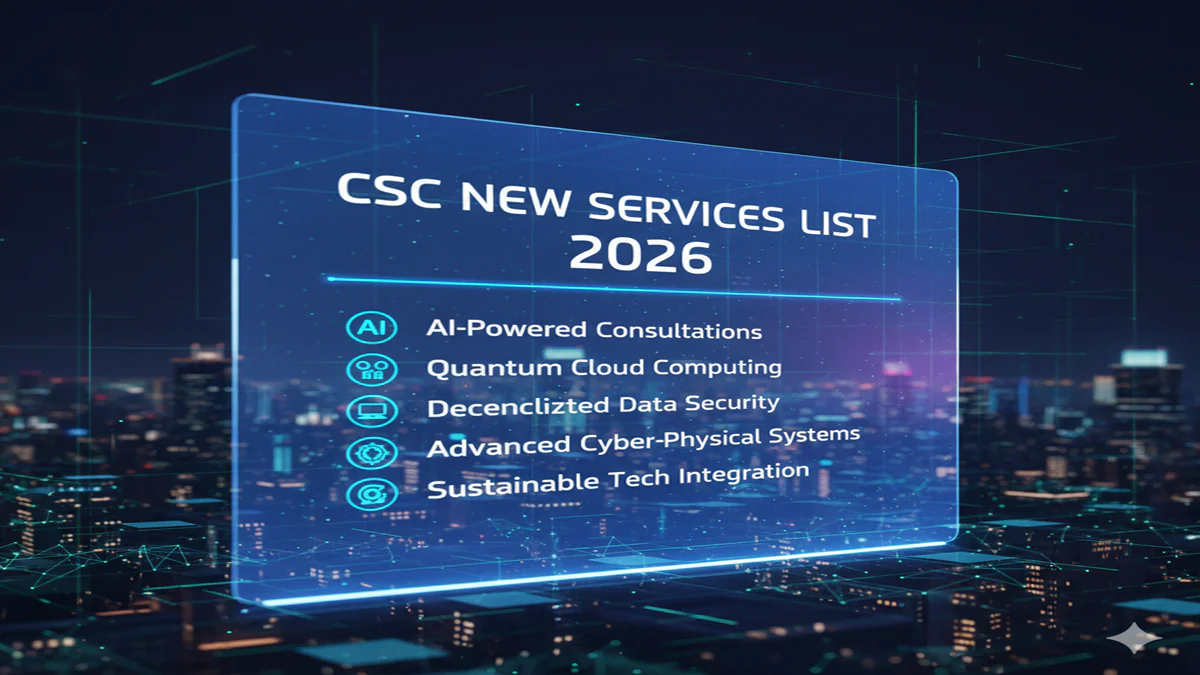
CSC New Services List 2026: डिजिटल सेवा पोर्टल पर आई धमाकेदार सर्विस! जानिए VLEs के लिए कमाई के नए मौके।
Csc New Services List 2026: Introduction: Dosto, agar aap ek CSC VLE (Village Level Entrepreneur) hain, toh aapke liye ek bahut badi khushkhabri hai. Digital India mission ke tahat CSC New Services List 2026 jaari ho gayi hai. Har saal ki tarah, is saal bhi NTA aur sarkari vibhagon ne milkar CSC portal par kai aisi services jodi hain jo na sirf nagrikon ka kaam aasaan karengi, balki VLEs ki income ko bhi boost karengi.
Aaj ke is article mein hum विस्तार (detail) mein baat karenge ki Digital Seva Portal par kaunsi nayi services live hui hain aur aap unka fayda kaise utha sakte hain.
1. Government (G2C) New Services 2026
Csc New Services List 2026: Sarkari services hamesha se CSC ki reedh ki haddi (backbone) rahi hain. Is saal niche di gayi services par focus hai:
- PM Vishwakarma Yojana 2.0: Karigaron ke registration aur loan process mein VLEs ka bada role hoga.
- Abha Card & Health ID Updates: Health sector mein ab naye health lockers aur digital prescription services ko joda gaya hai.
- New Pension Schemes: Atal Pension Yojana ke saath-saath rajya sarkaron ki nayi pension yojanaon ka registration ab CSC se hoga.
- Aadhaar Seva (Big Update): Kai rajyon mein ab CSC Centers ko ‘Document Update’ ke saath-saath naye Aadhaar enrollment ki permission milne wali hai.
2. Banking & Financial Services (BC Point)
Csc New Services List 2026: 2026 mein CSC Banking sector mein bada badlav aaya hai:
- Instant Account Opening: Ab kai private banks ke saath milkar CSC ‘Paperless Instant Account’ ki suvidha de raha hai.
- Credit Card Application: Ab VLEs apne center se Axis, HDFC aur SBI ke credit cards apply kar sakte hain, jispar heavy commission mil raha hai.
- Micro-ATM 2.0: Naye aur fast Micro-ATM machines launch hui hain jo 5G connectivity ko support karti hain.
3. Education & Skill Development
Csc New Services List 2026: Education sector mein CSC Academy ne kai naye courses shuru kiye hain:
- AI for Rural Youth: Artificial Intelligence ka basic course ab har gram panchayat mein CSC ke zariye pahunchega.
- Cyber Security Course: Internet ke badhte khatron ko dekhte huye, sarkari cyber security certification ab CSC se kiya ja sakta hai.
- Skill India Digital Hub: Is portal ke zariye job mela aur placement services ab VLEs manage karenge.
4. Agriculture & E-Commerce (Grameen e-Store)
Csc New Services List 2026: Kisanon ke liye CSC ab ek ‘One-Stop Shop’ ban gaya hai:
- Drone Services: Khet mein dawayion ke chidkaw (spray) ke liye drone booking ki service kai centers par shuru ho chuki hai.
- Grameen e-Store New Products: Ab local brands ke saath-saath bade electronics brands bhi e-store par available hain, jisse VLEs ko product delivery par achha commission mil raha hai.
- Soil Testing Kits: Kisano ki mitti jaanchne ke liye naye portable kits CSC centers ko diye ja rahe hain.
5. CSC VLE Commission Structure 2026
Csc New Services List 2026: Nayi services ke saath commission mein bhi badlav kiya gaya hai. Banking aur Insurance services par ab pehle se 10-15% zyada commission mil raha hai. VLEs ko chahiye ki wo apne Wallet Top-up ko hamesha ready rakhein taaki transaction mein koi dikkat na aaye.
How to Activate New Services? (Steps)
Csc New Services List 2026: Nayi services ko apne portal par activate karne ke liye niche diye gaye steps follow karein:
- Digital Seva Portal par login karein.
- ‘Services’ tab par click karein aur ‘New Arrivals’ section check karein.
- Kisi bhi nayi service par click karke uska VLE Registration form bharein.
- Kuch services ke liye aapko apne District Manager (DM) se sampark karke approval lena pad sakta hai.
Conclusion: VLEs ke liye sunehra mauka!
CSC New Services List 2026 ne yeh saabit kar diya hai ki aane wala waqt digital entrepreneurs ka hai. Agar aap ek active VLE hain, toh in sabhi services ki jaankari rakhein aur apne gaon ke har ghar tak ise pahunchayein. Isse na sirf gaon ka vikas hoga, balki aapki income bhi lakhon mein pahunch sakti hai.
A Gateway to the Future: Exploring the CSC New Services List for 2026
Introduction: The CSC as a Digital Nerve Center
Csc New Services List 2026 In the vast and often complex landscape of India’s digital governance, Common Service Centers (CSCs) stand as beacons of accessibility and empowerment. These village-level entrepreneurial outlets, more than 5 lakh in number, have evolved from simple service delivery points to robust digital infrastructure hubs. They bridge the critical “last mile” gap, ensuring that the benefits of technology and government schemes reach every corner of the nation, from bustling peri-urban towns to the most remote hamlets.
The annual release of the CSC New Services List is a much-anticipated event, signaling the next wave of digital inclusion and entrepreneurial opportunity. As we project forward to 2026, this list is expected to be a transformative document, reflecting broader national priorities like the Digital India 2.0 vision, Atmanirbhar Bharat, and the burgeoning digital economy. This article delves into the anticipated services, their impact, and the strategic vision they represent for India’s digital future.
Section 1: The Evolutionary Trajectory – From Service Kiosks to Integrated Service Ecosystems
Csc New Services List 2026: To appreciate the 2026 list, one must understand the CSC’s journey. Initially focused on essential government-to-citizen (G2C) services like certificate issuance, bill payments, and banking, CSCs have steadily expanded into business-to-citizen (B2C) and business-to-business (B2B) domains. They have become training grounds (Digital Saksharta), healthcare access points (telemedicine), and insurance facilitators.
The 2026 list is predicted to accelerate a paradigm shift: from offering discrete services to providing integrated, life-cycle solutions. The VLE (Village Level Entrepreneur) will transition from a service operator to a comprehensive solution provider for their community. This shift is driven by advanced digital infrastructure (like BharatNet), widespread Aadhaar seeding, and increasing digital literacy.
Section 2: Anticipated New Services for CSC 2026 – A Detailed Forecast
Csc New Services List 2026: Based on current policy directions and technological adoption curves, the CSC New Services List 2026 is likely to be organized around several key thematic pillars.
Pillar 1: Advanced Healthcare and Tele-wellness
Csc New Services List 2026: CSCs will move beyond basic teleconsultation to become holistic wellness centers.
- AI-Powered Preliminary Health Screening: Integration of approved, portable AI diagnostic tools for basic eye checks (retinopathy), lung function, and vital sign analysis, with reports forwarded to partnered doctors.
- Mental Health and Wellness Counseling: Secure video-kiosk sessions with licensed counselors and psychologists, addressing the growing need for mental health support in rural and semi-urban areas.
- National Digital Health Mission (NDHM) Full Stack Services: Beyond generating Ayushman Bharat Health Accounts (ABHA IDs), CSCs will assist in uploading historical health records, accessing digital prescriptions, and managing consent for data sharing.
- Pharmacy and Lab Network Hub: End-to-end management of diagnostic sample collection for partner labs and facilitated delivery of medicines from empaneled pharmacies.
Pillar 2: Education 4.0 and Future Skills
Csc New Services List 2026: CSCs will become nodal points for disruptive education and skill development.
- Regional Language VR/AR Skilling Modules: Using affordable Virtual/Augmented Reality setups, VLEs can offer immersive training in fields like tractor repair, electrical wiring, or plumbing in the local language.
- Credit-linked Micro-Learning Platform Access: Facilitating enrollment and administration for government-linked nano-degree programs (3-6 months) in areas like drone operation, solar panel maintenance, and digital marketing.
- Competitive Exam Preparation Hubs: High-speed internet access to curated, low-cost test preparation platforms for state and national exams, with periodic proctored mock tests conducted at the CSC.
- Student Career Counseling and Portfolio Building: Guiding students on National Credit Framework (NCrF) and helping them build digital portfolios of their projects and skills.
Pillar 3: Agriculture 2.0 – From Precision to Prosperity
Csc New Services List 2026: Services will deepen to cover the entire agricultural value chain.
- Drone-as-a-Service (DaaS) Booking and Coordination: CSCs will act as booking nodes for farmer groups to access certified drone services for pesticide spraying, mapping, and yield assessment.
- FPO (Farmer Producer Organization) Digital Facilitation: End-to-end digital support for FPOs, including ERP software access, e-marketing on state and national platforms, and logistics coordination.
- Predictive Analytics for Crop Management: Offering subscription-based reports (generated from public and private satellite data) on weather forecasts, pest alerts, and optimal irrigation schedules for specific land plots.
- Digital Warehouse Receipts and E-Negotiable Warehouse Receipts (e-NWR) Services: Assisting farmers in converting stored produce into tradeable digital assets to access better credit and prices.
Pillar 4: Financial Inclusion & Fintech 2.0
Csc New Services List 2026: Moving beyond deposits and withdrawals to sophisticated financial products.
- Insurtech Integration: Simplified sale and claim initiation for micro-insurance products tailored for crops, livestock, and specific health conditions, using simplified parametric triggers.
- Pension and Wealth Management Advisory: Basic advisory services for the National Pension System (NPS), Atal Pension Yojana (APY), and mutual fund SIPs, in partnership with regulated entities.
- Grievance Redressal and Financial Literacy Workshops: Regular camps on avoiding digital financial fraud and using the integrated ONDC (Open Network for Digital Commerce) and RBI’s complaint management systems.
- Credit Linkage for Green Assets: Facilitating applications and documentation for subsidized loans for solar panels, biogas plants, and electric vehicles.
Pillar 5: Governance 2.0 and Legal Empowerment
- Assisted Legal Services (Tele-Law 2.0): Enhanced video conferencing facilities for notarization, document review, and more complex legal consultations beyond basic advice.
- Customized Government Scheme Matching: AI-driven tools that scan a citizen’s data (with consent) to proactively identify and guide them through all eligible state and central schemes.
- Local Government (Panchayat) Digital Secretarial Services: Offering SaaS platforms for Gram Panchayats to manage their meetings, finances, and asset registers digitally.
- Public Grievance Advanced Facilitation: Assistance in filing and tracking complex grievances across multiple portals (CPGRAMS, state portals) with escalation support.
Section 3: The Enabling Ecosystem – Technology and Training for 2026
Csc New Services List 2026: The success of these services hinges on parallel upgrades:
- Infrastructure: Wider deployment of 5G-ready BharatNet, mandatory upgrade to biometric/Aadhaar auth 2.0 devices, and secure cloud-based CSC platforms.
- VLE Training: A massive re-skilling initiative through the CSC Academy, using train-the-trainer models and digital certifications for VLEs in specialized domains like health, finance, and agriculture.
- Interoperability: Deepening integrations with key digital public infrastructures—Aadhaar (Auth), UPI (Pay), DigiLocker (Docs), ABHA (Health), and ONDC (Commerce).
Section 4: Impact and Challenges – A Realistic Assessment
Expected Impact:
- For Citizens: Dramatic reduction in time, cost, and distance to access world-class services, leading to improved quality of life and economic participation.
- For VLEs: Significant new revenue streams, elevating their social status to that of a “Digital Village CEO.”
- For Governance: Enhanced transparency, reduced leakage in schemes, and data-driven policy-making based on anonymized service uptake trends.
- For the Economy: Formalization of the rural economy, boosting in-situ entrepreneurship and creating a distributed digital services workforce.
Potential Challenges:
- Digital Divide Persistence: Gender, literacy, and disability gaps could limit access.
- VLE Economics: Ensuring adequate and timely commissions for complex services is critical.
- Infrastructure Gaps: Unreliable power and connectivity in some regions remain a hurdle.
- Data Privacy and Security: As services become more personal, robust data protection protocols are non-negotiable.
Conclusion: The CSC 3.0 – Building a Digital Nation, One Village at a Time
The CSC New Services List 2026 is not merely an addition of tasks; it is the blueprint for CSC 3.0—an intelligent, integrated, and community-centric platform. It represents a future where a rural entrepreneur in Dhar, a homemaker in Kutch, and a farmer in Warangal have the same digital toolkit for progress as their urban counterparts.
By harnessing the power of entrepreneurship and public-private partnership, this evolving model holds the key to achieving not just digital inclusion, but holistic digital empowerment. The 2026 list, therefore, is a commitment to ensuring that India’s digital story is not written only in its metropolitan hubs, but in its 600,000 villages, with the CSC VLE as the pivotal author of change.
Frequently Asked Questions (FAQs)
1. As a citizen, what is the most significant change I can expect from the 2026 services compared to what CSCs offer today?
Csc New Services List 2026: You will experience a shift fromtransactional to transformationalservices. Instead of just paying a bill or getting a certificate, you can accessintegrated solutions. For example, for a health issue, the CSC could provide an AI screening, a teleconsultation, a digital prescription, and home-delivered medicine—all in one visit. It’s about end-to-end problem solving, not single services.
2. I am a CSC VLE. Will I need extensive new training or investment to offer these advanced services?
Csc New Services List 2026: Yes, but it will be a structured and supported transition. TheCSC Academyis expected to roll out specialized, modular training programs (online and offline) for new service verticals like health diagnostics, agri-tech, and fintech. The investment model will likely be a mix ofsubsidized government-provided equipment(like advanced diagnostic tools) andmandatory VLE self-investmentin specific certifications or minor hardware upgrades. The focus will be on creating specialist VLEs who can serve as regional anchors for complex services.
3. How will the privacy and security of my sensitive data (health, financial) be protected with these new, more intrusive services?
Csc New Services List 2026: Data protection will be paramount. All new services will be designed to comply with theDigital Personal Data Protection Act (DPDPA), 2023. The architecture will rely onIndia Stack principleslike consent layers. You will provide explicit, granular consent via your Aadhaar or DigiLocker for what data is shared and for how long. Transactions will be audited, and VLEs will undergo mandatory data privacy training. The system will move from mere Aadhaar authentication to a more secure, consent-based data sharing framework.
4. Many of these services (like Drone-as-a-Service or VR Skilling) sound expensive. Will they truly be affordable for the common rural citizen?
Csc New Services List 2026: Affordability is a core design principle. The government’s role will be tosubsidize the initial infrastructureat the CSC level and negotiate bulk-ratePublic-Private Partnership (PPP) modelswith service providers. The cost to the end-user will not be the full market rate. For instance, a VR skilling session might be part of asubsidized government skilling voucher, and drone spraying will be booked by afarmer cooperativeto distribute costs. The model is “shared access,” making advanced tech affordable.
5. What happens if a service fails or there is a dispute (e.g., a wrong diagnostic report or an insurance claim denial)? What will be the grievance mechanism?
Csc New Services List 2026: A robustthree-tier grievance redressal systemis anticipated:
Level 1 (Service Provider):A mandatory, time-bound escalation path with the actual company providing the service (e.g., the telemedicine partner, the insurance company).
Level 2 (CSC SPV):The CSC e-Governance Services India Ltd, the overseeing body, will have a dedicated vertical for monitoring and resolving disputes on the platform.
Level 3 (Independent Ombudsman):Escalation to the relevant sectoral ombudsman (Banking, Insurance, Healthcare) or the integratedDigital India grievance portal. The CSC VLE’s role will be to assist you in documenting and navigating this process.